
Spin Coater Price in India for Research Lab:
What the Number on the Quote Doesn’t Tell You
The price you’ll actually pay is not the sticker price, it’s the sum of the sticker, the downtime, the consumable waste from non-reproducible runs, and the months you lose waiting for a repair or a procurement cycle. That total is invisible on every industry portal listing.
The 16× Problem
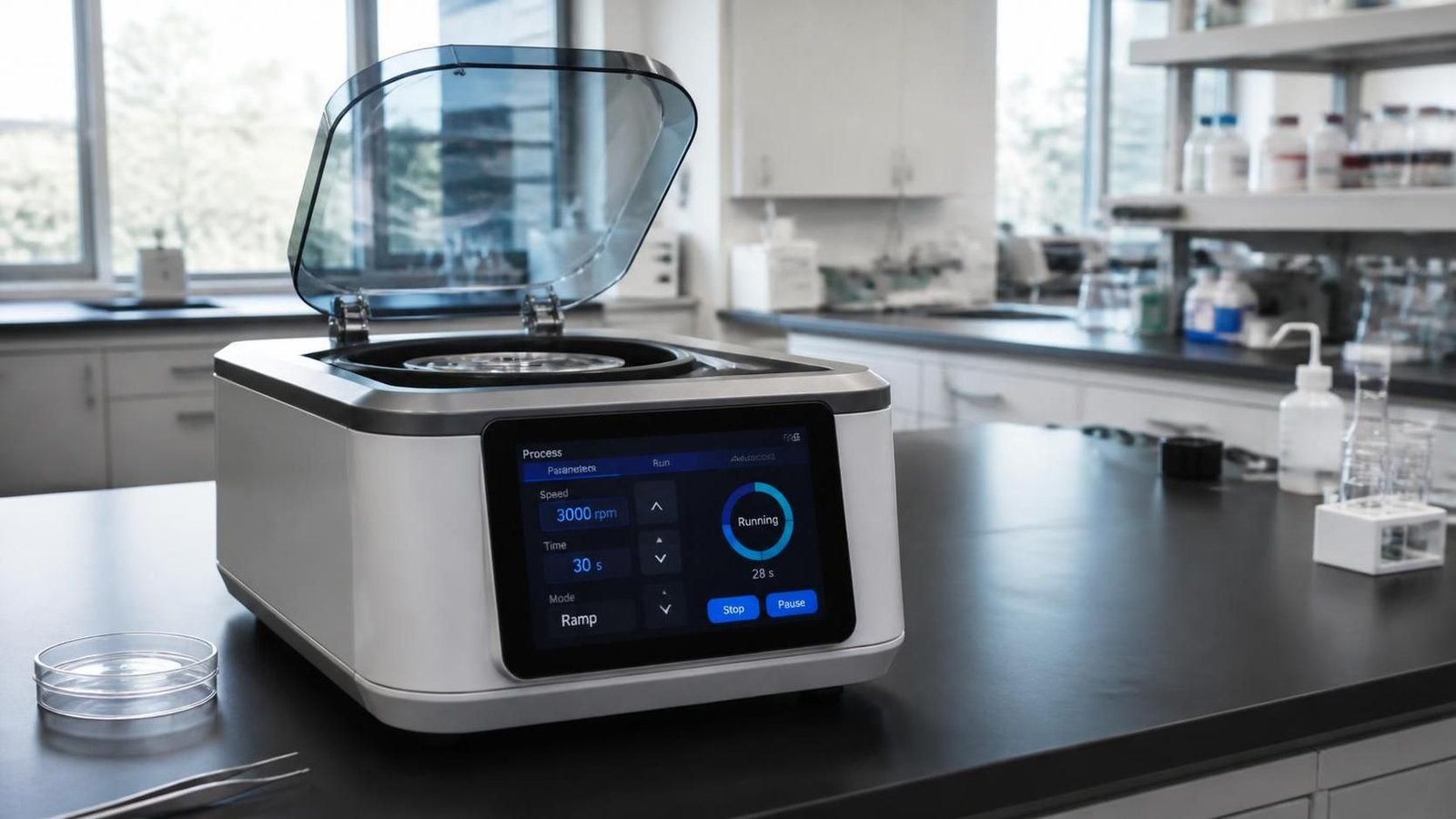
You’ve seen the numbers, ₹55,000 on TradeIndia, ₹1,75,000 from an Indian research-grade manufacturer, or ₹10,00,000 for a Laurell. A 16× spread for what looks like the same machine: a motor, a chuck, a chamber, a controller.
Here’s what the list on spin coater price in India for research lab doesn’t show:
- The low cost unit that drifts ±8% in RPM produces films that don’t replicate across your 5 replicates. You find out when a reviewer writes “Please demonstrate reproducibility across at least 5 independent depositions with stated process parameters.”
- The ₹1.8L unit with a broken vacuum seal sits idle for 6 weeks waiting for a technician from another city. As your submission deadline slips, the conference abstract window closes.
- The ₹10L imported unit works perfectly — until the model is discontinued globally and your spare parts become a 14-week international shipping exercise.
You’re not buying a machine, you’re buying a reliability contract with a 3-year research timeline attached.
Before You Compare Prices: 4 Questions That Eliminate 60% of Options
Answer these in order, as each answer narrows the field.
Q1: What RPM stability does your application actually require?
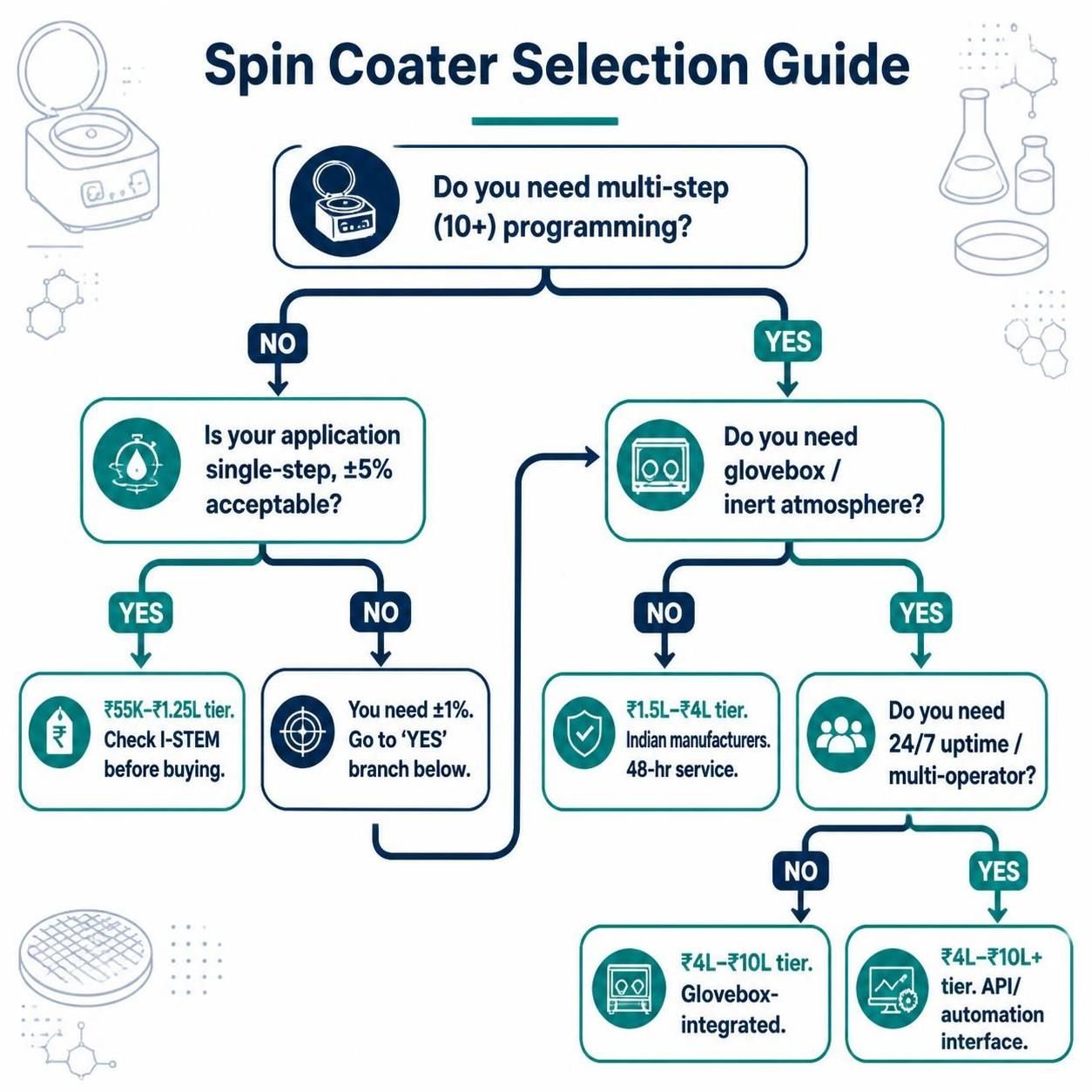
Not max RPM, the stability under load. Photoresist for MEMS: ±5% is acceptable. Perovskite PSC, 2D materials, OLED: you need ±1%. This single spec eliminates the entire ₹55K–₹1.25L tier for most active research work.
Q2: How many steps does your process need?
Single-step (one speed, one time) is a ₹55K problem. Multi-step with antisolvent quenching (accelerate → spin → pause → re-accelerate) is a ₹1.5L+ problem. If your next paper involves 2D/3D perovskite or sequential layer deposition, you need 10+ programmable steps. A 2026 Springer paper (Azidin et al.) confirmed that a cost-effective coater matches a commercial system for single-step applications — but the moment you add antisolvent quenching at 8,000 RPM, the gap reappears.
💬 If you’re planning a multi-step perovskite or antisolvent process and not sure if your current coater can handle it — Start a Chat — send your current spin parameters (RPM, time, steps) . Get a specialist to guide you: can your coater do it, and if not, what’s the minimum spec gap.
Q3: What is your true downtime cost?
Calculate: your cost per day of research × expected downtime per year. A ₹1.8L Indian unit with a 48-hour service SLA costs less over 3 years than a ₹5L imported unit with a 3-week SLA — if your timeline is measured in months, not years.
Q4: What is your procurement path?
If you’re buying through GeM, a university tender, or a DST grant, the “price” is not the number on the invoice. It’s the number that survives L1 evaluation, OEM certification, and 3 levels of sign-off. A ₹1.8L unit that clears GeM in 6 weeks beats a ₹1.2L unit stuck in exemption justification for 4 months.
💬 If you’re specing ancillary equipment for a new ISM facility and haven’t placed your spin coater yet — Start a Chat — send a rough sketch of your floor plan (hand-drawn is fine). Application specialists will mark optimal placement for vibration isolation, fume routing, and litho-to-wet-bench workflow. They’ve done this for multiple ISM lab designs this year.
The Spec Tiers (Not Price Tiers)
| What You Need | Spec Floor | 2026 Price Range | Who It’s For |
| Single-step, ±5%, 4″ chuck | Basic programmable | ₹55K – ₹1.25L | Undergrad projects, training labs |
| Multi-step (10+), ±1%, 4–6″ chuck, vacuum option | Research-grade | ₹1.5L – ₹4L | Active PhD, perovskite/OLED/MEMS, publication-grade |
| 12″ chamber, glovebox-compatible, API interface, 24/7 | Advanced | ₹4L – ₹10L | ISM labs, pilot lines, multi-operator |
| Best-in-class, discontinued-model risk, 3-week service | Imported | ₹10L – ₹25L+ | Labs with dedicated service contracts |
Disclosure: We’re not the vendors. Contact the manufacturer and supplier so you can weigh what follows accordingly.
5 Signs You Do NOT Need to Buy (Yet)
This section is the one most vendor blogs won’t write when discussing spin coater price in India for research labs. I’m writing it because it’s the perspective many lab group chats may want.
- Your target film thickness is >5μm. Spin coating is the wrong tool, you need doctor-blading or slot-die.
- Your substrate is >8 inches. You need a slot-die or spray coater, not a spin coater.
- Your lab has <2 active users and you’re on I-STEM. Check the I-STEM equipment portal — a partner institution may have a spin coater you can access for a fraction of the purchase cost, so you may not need to own one.
- Your application is single-step and your current DIY setup produces films within ±10% thickness variation. The 2026 Azidin et al. paper (Springer) showed a cost-effective coater is statistically equivalent to a commercial unit for this use case, so your ₹5,000 setup might be fine.
- You’re 12+ months from the process step that requires spin coating. If you’re in the GaN epitaxy phase and won’t reach passivation for a year, don’t buy now; the spec you need in 12 months may differ from today’s.
💬 If you’re running a DIY or fan-based setup and a reviewer just asked for 5 replicates — Start a Chat — send a photo or 10-sec video of your setup running. Get named the one thing limiting your film uniformity (RPM jitter, chuck runout, drop volume, or substrate flatness) and know whether it’s a ₹500 fix or a real upgrade. No judgement.
The Decision Tree (Screenshot This)
What To Do This Week (Not This Quarter)
You don’t need to buy anything today, you need to know where you are.
💬 If you’re drop-casting or dip-coating and your films have visible edge-to-centre variation — Start a Chat — send a photo or a profilometer trace. Get to know in two sentences what spin coating would change, what it wouldn’t, and whether it’s worth it for your application. If the answer is “keep doing what you’re doing,” they’ll say that.
💬 If you’re using a shared coater and waiting 3+ days per batch — Start a Chat — send a rough count of films you needed last month vs. films you completed. Get back a 3-line calculation: your cost per lost day, and the break-even point for a dedicated unit. No product recommendation. Just the math you can paste into an email to your HOD.
Who Actually Signs the Cheque
| If you are… | Forward this to… | What they need from this article |
| PhD student / research fellow | Your HOD or PI | The 4-question framework (spec checklist) + the ROI calculation |
| HOD / PI | Procurement officer | The spec tiers table (L1 evaluation threshold) + the “don’t buy” section (justification for not over-buying) |
| Procurement officer / lab manager | — | The GeM note in Q4 (exemption justification paragraph) + the decision tree (tender spec) |
The query that should replace “spin coater price in India for research lab” in your search bar is: “What is the minimum RPM stability and step count my application requires, and what does that cost in India with a 48-hour service SLA?” That question has a number, the other one doesn’t.
If this saved you 30 minutes of scrolling through common eMART listings, forward it to the person in your lab who actually signs the purchase order.
FAQs.
Research-grade spin coaters in India range from ₹55,000 (basic programmable, ±5% stability) to ₹25,00,000+ (imported, best-in-class). The most common purchase tier for active PhD and perovskite/OLED research is ₹1.5–4 lakh, where Indian manufacturers offer ±1% RPM stability with 48-hour local service.
Total cost of ownership = sticker price + expected downtime cost + consumable waste from non-reproducible runs + procurement cycle delay. A ₹1.8L Indian unit with 48-hour service can cost less over 3 years than a ₹5L imported unit with 3-week service, because research downtime is measured in lost publication windows.
If your lab has fewer than 2 active users and your institution is registered on the DST I-STEM portal, you may be able to access a spin coater at a partner institution for a fraction of the purchase cost. Check istem.gov.in before buying. Ownership makes sense at 3+ users or when your process requires 24/7 access.
Perovskite PSC research requires ±1% RPM stability under load. This is because film thickness is inversely proportional to spin speed, and ±3–5% drift introduces 10–15% thickness variation, which directly affects PCE reproducibility. Single-step applications may tolerate ±5%, but antisolvent quenching at 8,000+ RPM requires ±1%.
GeM procurement adds 6–16 weeks to the purchase timeline and introduces L1 (lowest-price) evaluation risk. A ₹1.8L unit that clears GeM in 6 weeks is functionally cheaper than a ₹1.2L unit stuck in exemption justification for 4 months, because the research timeline is the binding constraint, not the sticker price.
For single-step applications with ±10% thickness tolerance, a 2026 Springer study (Azidin et al.) showed a cost-effective DIY coater produces films statistically indistinguishable from a commercial system. For multi-step processes, antisolvent quenching, or ±1% stability requirements, a commercial research-grade unit is necessary.
GaN HEMT passivation (SiNx or Al2O3 spin coating) requires ±1% RPM stability, multi-step programming (for sequential layer deposition), and typically a 4–6 inch chuck for 6-inch wafers. Glovebox compatibility is recommended for moisture-sensitive Al2O3 sol-gel precursors.
2D/3D perovskite fabrication with antisolvent quenching requires a minimum of 5 steps (spin → pause → antisolvent drop → re-spin → final spin). For multi-layer structures (perovskite + transport layers in one session), plan for 10+ steps. Most research-grade Indian spin coaters offer 10-step standard with 100-step customization.
→ Doubt? Question?
Don’t guess. Send details. Get a fact-checked verdict from an Application Specialist. No sales pitch, no fluff.
🗨 Start a Chat→ Application Fit-Check
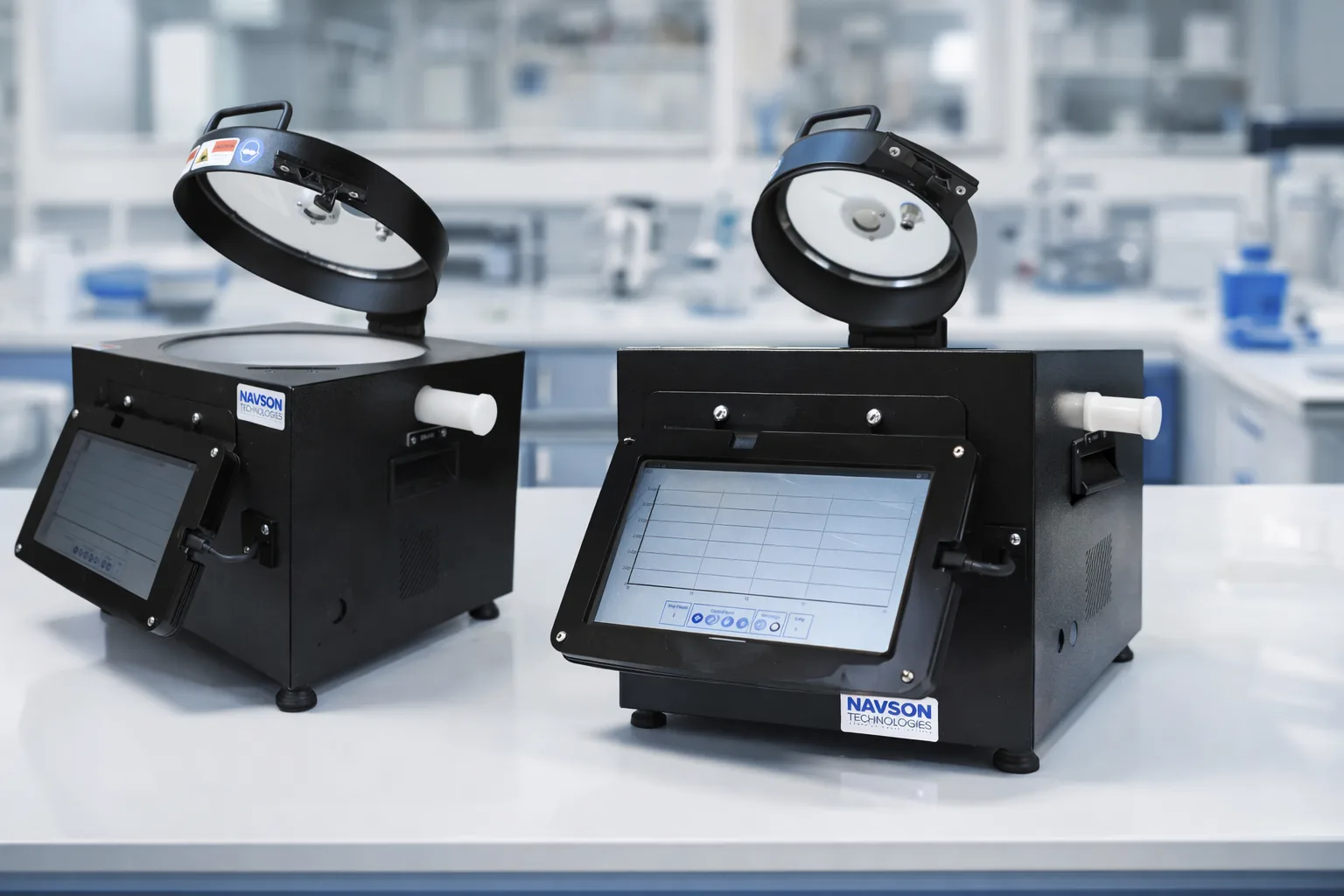
Get a free NT12000 Process-Fit & Configuration Review by Application Engineers at Navson Technologies
🏷️ Sponsored
Important Disclaimer
Scientific EQ. @PULSE offers general information and best practices related to scientific research. It is not intended as a substitute for professional training, specific equipment operation manuals, or a comprehensive understanding of the materials involved. Users bear sole responsibility for ensuring safe operation, appropriate material selection, and adherence to all relevant safety and environmental regulations.
Should you identify any discrepancies or have questions regarding the content of this guide, please contact us promptly at scientificeq@aidasinc.com. We are committed to rectifying any inaccuracies and will gladly acknowledge contributing sources.