

The thinking behind the work.
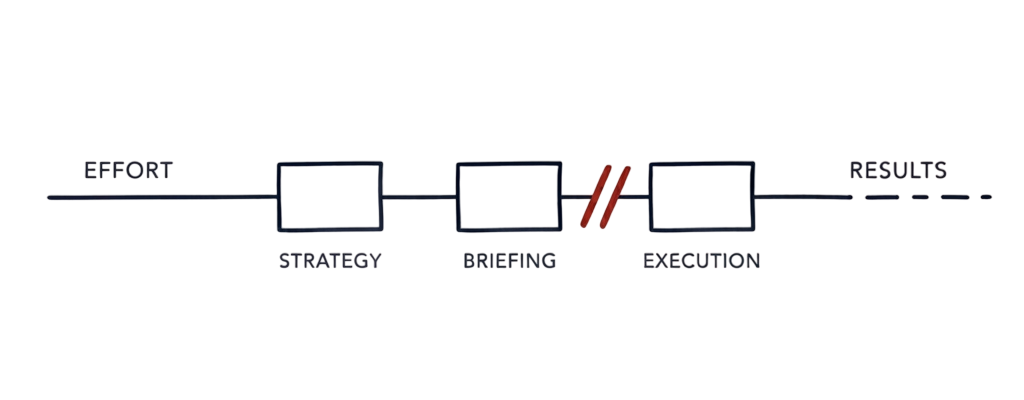
Most growth problems are not execution problems, they are structural ones.
Businesses come to us with campaigns running, teams in place, and money being spent. But results are inconsistent — the “Circuit” is open — and no one can explain why. We exist to find where the system is breaking, fix it, and build something that produces consistent results.
The Structural Failure of the Standard Agency Model
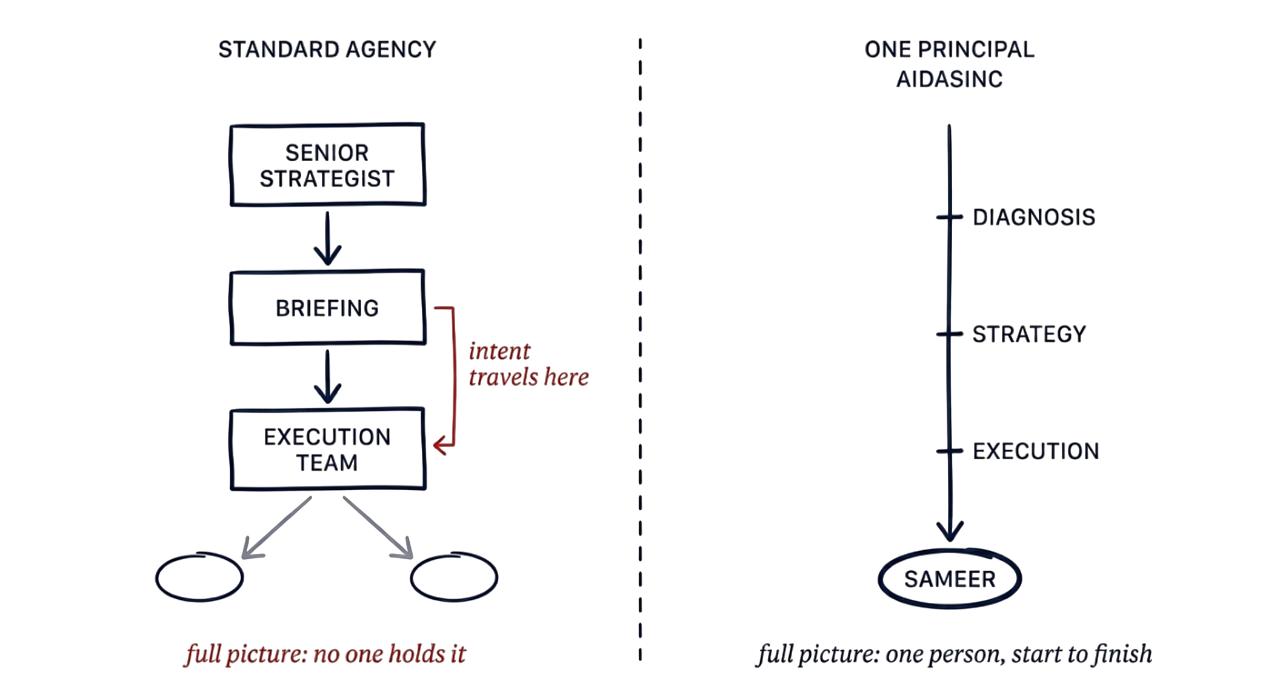
The traditional model has a built-in “Transmission Gap”
Strategy is sold by a senior partner who understands your P&L, then, the work is handed down to a junior team that received a briefing, not the conversation. Strategic intent is summarized, interpreted, and eventually lost. When results fail, no one can explain why because no one holds the full picture.
@aidasinc, we work differently. We eliminate the transmission gap.
One architect. From diagnosis to outcome.
Sameer works directly with every client—through the diagnosis, the alignment, and the execution. The person who understands your business is the person responsible for the outcome.
When one person holds the full picture — your market, your history, your constraints — the recommendations stay coherent, the execution stays on track, and the results become explainable. This is not a feature, it is the reason the work is reliable.

Sameer trained as an Electrical Engineer before moving into marketing. That training defines his method: If the circuit is incomplete, adding more power changes nothing. In business, “more power” usually means more ad spend or more push. But if your system has a gap, that power is wasted.
25 years of professional experience. 18 years in digital. 120+ businesses across India, the UK, and the US. Seven industries — architecture, healthcare, manufacturing, real estate, consumer brands, education, and hospitality.
“Every business I have worked with had the same feeling — something is not working, but no one can name exactly what. After two decades across industries, I know where to look and how to fix the gap.” — Sameer Bhaduri, Growth Strategist · Co-Founder
How an engagement actually works.
The starting point is always a Strategic Diagnosis — a focused review of where your growth system currently stands. No execution is proposed before that picture is clear.
The Strategic Diagnosis (First 30 Days)
Find exactly what is and isn’t working
You get a clear picture of what is actually happening, where you are earning attention, where you are losing people, where money is working, and where it is not. And what to fix first.
Strategic Alignment & Team Enablement
Align and build toward consistent results
We don’t just hand you a report and leave you with a high-end to-do list. Sameer embeds as your Fractional CGO. We design the system and coach your internal team or agencies to run it. We build Institutional Intelligence so the system stays rewired long after we leave.
If the work warrants a longer engagement, the revenue system design and execution phase follows — search, content, paid, web — structured the same way, with the same principal-led model. The Strategic Diagnosis is always a standalone engagement. There is no obligation beyond it. If the diagnosis finds nothing worth fixing — that is exactly what you will be told.
The next step is a conversation.
Not a pitch — a focused review of what is actually happening in your business, and whether there is a structural problem worth fixing.