

The Ghost in the Machine:
Why Your Industrial Marketplace Leads Don’t Convert
If you are spending $3K–$12K per month on digital growth and still seeing high activity but inconsistent revenue, enquiries that don’t turn into serious deals, and sales teams staying busy but forecasts slipping. You are not dealing with a visibility problem, you are dealing with revenue leakage inside your system.
This article is for founders of industrial manufacturers who see high activity on their digital assets, or on platforms like LabX, but stagnant revenue in their bank accounts.
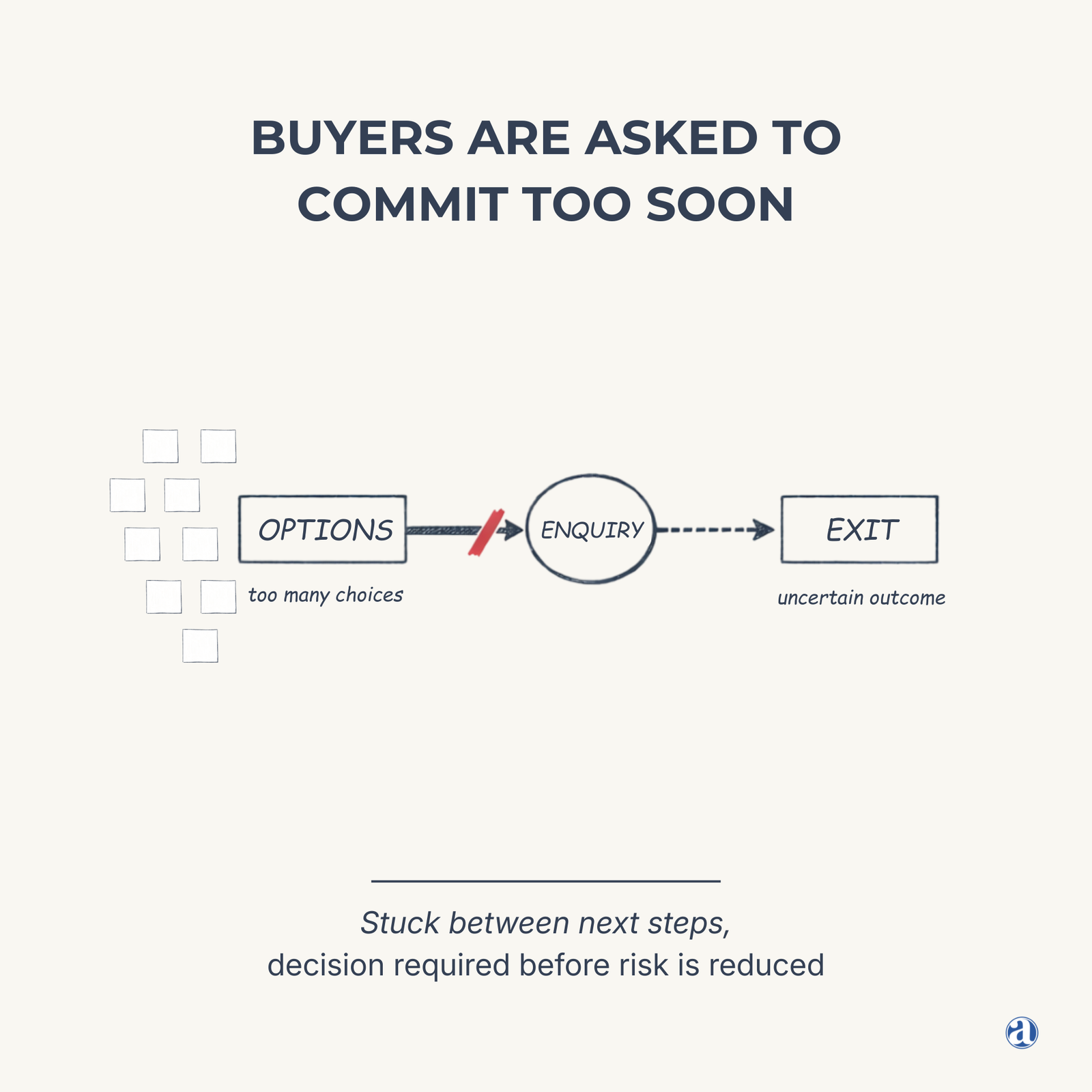
What Most Get Wrong
Most people assume this is a sales problem or a lead-quality problem, concluding that buyers aren’t “serious” — both are incomplete. Spend enough time in a marketplace like LabX, and you see the opposite. Buyers are highly engaged, like in dense categories such as chromatography, HPLC, or mass spectrometry, they revisit listings for weeks. So it’s not unusual to see dozens—or even hundreds—of comparable systems listed at any given time.
They compare every specification, so the issue isn’t lack of interest. Buyers move deliberately: opening multiple listings, comparing configurations, and revisiting the same products across sessions that can span days or weeks. This is not passive traffic; it’s active evaluation, which is why outcomes often feel disconnected from effort. For many manufacturers, revenue doesn’t scale in proportion to that activity. The problem is that your marketing reaches the right people, but your setup works against you. Something breaks between intent and transaction, and fixing it requires examining the hidden revenue loss in marketplaces.
The Discovery vs. Approval Gap
Industrial marketplaces are optimized for discovery, helping buyers determine what they want with remarkable efficiency. What they don’t control is what happens after that moment of intent. On platforms like LabX, for example, the journey starts with a researcher, but once a decision leaves the lab and enters the organization, the dynamics of the deal change. Here is the gap: your marketplace listing communicates with a scientist, but your revenue is controlled by a procurement officer. Once the decision leaves the lab, it encounters three invisible walls:
- Procurement evaluates the vendor against criteria the scientist never considered.
- Is this vendor reliable?
- Are they approved?
- What is the downside if something fails?
- Compliance → Documentation Risk
- Certifications (ISO, validation)
- Audit readiness
- Regulatory exposure
- Finance → Capital Justification questions budget timing and necessity.
- Budget timing
- ROI vs competing internal projects
- Cost vs risk trade-off
At this stage, the original decision is no longer the same decision. It is not unusual for a buyer to settle on a six-figure system, only for the conversion to break down during internal review. The product isn’t the issue; the problem lies in the invisible filters of vendor validation and risk thresholds that were never addressed during the discovery phase.
Why More Activity Makes It Worse
The natural instinct when growth stalls is to increase inputs, more traffic, more listings, more lead generation — but in the industrial marketplace, conversion problems often stem from too much choice without enough differentiation.
1. The Safety Pivot
When multiple listings appear technically similar, buyers stop asking “Which machine is best?” and start asking “Which vendor is safest?” This information is rarely obvious in a standard listing, and consequently, buyers compensate by delaying. You see this in the behavior: repeated visits and extended comparison cycles without an inquiry.
2. The Hidden Layer: Non-Convertible Demand
Not all activity equals revenue — a meaningful share of marketplace inquiries does not represent purchasing readiness, some are exploratory (researching for future budgets ~ 6–24 months), others are price discovery for future budget cycles (academic or grant-driven timelines). When these enter the same pipeline as procurement-backed leads, they become indistinguishable, creating a pipeline that doesn’t close and a sales team that is “busy” but not “productive.”
That often leads to ignoring buyers who have budget, authority, and urgency (30–90 days), especially when businesses treat both identically. This results in sales effort wasted on non-convertible demand, inflated pipelines, and misleading forecasts.
The Signals of a “Ghost Pipeline”
This dynamic rarely announces itself directly as it shows up in patterns that feel familiar but are difficult to isolate:
- Acquisition costs (CAC) climb even as traffic remains steady.
- Sales cycles stretch beyond what product complexity justifies.
- Forecasts lose reliability despite stable top-of-funnel activity.
- High engagement but low deal velocity.
These signals indicate that your hidden revenue loss is accelerating, and you are capturing engagement, but you aren’t engineering the conditions required for an industrial purchase order.
The Missing Layer: Risk Data
At the point of decision, buyers need more than specifications — they need justification ammunition for internal approval. This is what most systems lack, the “Risk Data” that for high-value industrial purchases, includes:
- Vendor credibility (install base, references, case use)
- Compliance readiness (certifications, validation support)
- Lifecycle clarity (service, uptime, support guarantees)
- Commercial certainty (delivery timelines, warranty, escalation paths)
If this is not visible before enquiry, the buyer cannot confidently initiate the process.
Scaling the System, Not the Noise
When conversion becomes inconsistent, the typical response is to add more people and more tools. But without addressing the underlying friction, you are merely amplifying the flaws.
In a healthy setup, the system removes friction before the inquiry even occurs. Buyers move faster because you have already provided the “Risk Data”—the stability and compliance information—up front. The pipeline stops being a mix of “explorers” and “buyers” and becomes a clear path where you can see exactly who has the authority to purchase right now.
What changes when the system is aligned?
- Decision Velocity Increases: Buyers move with fewer interruptions because the “Risk Data” (vendor stability, compliance) is provided earlier.
- Pipeline Becomes Real: The pipeline reflects actual purchasing capacity rather than a mix of exploratory signals.
- CAC Stabilizes: You stop paying for traffic that cannot convert under your current structure.
- Revenue Becomes Predictable: The system becomes quieter and more dependable, revenue doesn’t spike—it stabilizes.
The Constraint That Stays Hidden — Why marketplace leads don’t convert
If platforms like LabX make anything clear, it’s this: demand is rarely the limiting factor. The constraint exists in the dark space between a buyer’s decision and an organization’s approval. It isn’t visible in listing performance, ad dashboards, or CRM stages, which is why the loss persists.
A portion of your pipeline was never capable of becoming revenue under your current structure—not because the demand wasn’t real, but because the conditions required for conversion were never in place. To grow, you don’t need more leads; you need to illuminate the path from intent to approval.
Most teams don’t see where the loss actually occurs.
We built a GTM diagnostic to map that gap — from buyer intent to internal approval.