
Social Media Marketing for Architects in India
The 5-Layer Visibility Stack: From Local Discovery to Enquiries
By Sameer Bhaduri | Aidasinc | Last Updated: October 23, 2026
Social media marketing for architects in India is not just about publishing more posts or producing better renders. It is about making your practice easier to discover, helping prospective clients understand your work, and giving them a clear way to contact you.
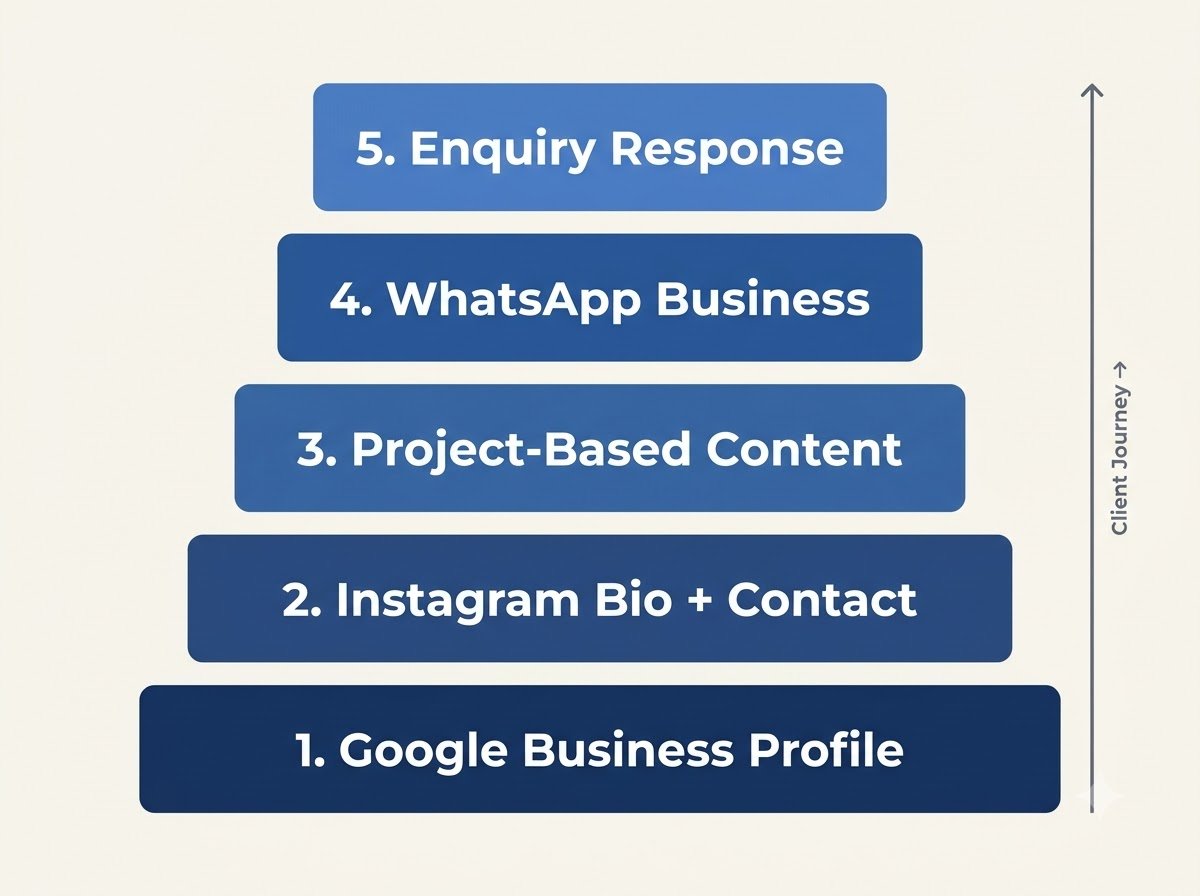
The 5-Layer Visibility Stack brings these tasks together in a practical sequence:
- Google Business Profile for eligible practices seeking local discovery.
- An Instagram bio that explains your services, location and contact route.
- Project-based content that demonstrates your design thinking.
- WhatsApp Business to organise business information and enquiries.
- A consistent process for responding to and tracking enquiries.
At Aidasinc, we have worked on digital visibility for expertise-driven businesses since 2008. This framework applies that experience to the needs of architecture and interior design practices in India. It is a practical operating model, not a promise of rankings or leads.
Consider a firm in Pune with 340 Instagram followers and 14 posts, all featuring finished renders. The work looked strong, but the firm reported receiving no direct messages over eight months. If this is a documented client example, it illustrates an important question: can a prospective client move from discovering a project to understanding the practice and making an enquiry? Attractive work is only one part of that journey.
Why Most Social Media Marketing for Architects Fails
Most architecture firms approach this as a content problem: “We need to post more”, or “We need better renders”, or “We need a content calendar.” It’s not a content problem, it’s a structural visibility problem.
Your client is investing in a ₹50L to ₹5Cr asset. They’re making that decision over 6 to 8 weeks of online research before they ever call you. At every touchpoint in that window, they’re looking at what’s visible online, not your 12 years of experience, and not your design philosophy. They’re looking at who shows up in the search results, who has a portfolio they can scroll through at 11 PM, who responds to a WhatsApp message within an hour.
If you’re not structurally present in the places they look, you’re not in the consideration set, and you’ll never know you weren’t. And there is a practical reason to take digital discoverability seriously.
Rentech Digital’s commercial directory dataset, updated on April 1, 2026, listed 14,549 architecture firms in India and reported that 7,401 did not have their own websites.
These figures describe that dataset; they should not be interpreted as an official count of all registered architects or as proof that every listed business is currently active. The finding nevertheless raises an important question for architecture practices: if a prospective client cannot find a useful website, a clear portfolio or a reliable contact route, what information will they use to compare firms?
They’re firms whose pipeline was built on referrals and never needed a digital floor, the floor is gone now. The referrals are slower, and someone else is filling the gap. Often, that someone is not another architect, it’s a home builder with a 4.8-star Google Maps listing, 60 reviews, and a WhatsApp number — Not a B.Arch graduate, probably not COA-registered — Just there first.
What Is the 5-Layer Visibility Stack?
The 5-Layer Visibility Stack is a sequential framework for connecting local discovery, social media, project storytelling, contact pathways, and enquiry management into one system.
| Layer | What It Is | Time to Complete | One-Time or Ongoing | What It Fixes |
| 1. Google Business Profile | Local discovery floor | 20 min | One-time (update per project) | “Architect near me” searches |
| 2. Instagram Bio + Contact | Discovery → interest bridge | 30 sec | One-time | “Who is this firm? How do I reach them?” |
| 3. Project-Based Content | Design thinking demonstration | 10 min per phase | Ongoing, built into site visits | “Do they understand my problem?” |
| 4. WhatsApp Business | Conversation + mini-portfolio | 45 min | One-time (update per project) | “Can I browse their work at 11 PM?” |
| 5. Enquiry Response | Conversion | Ongoing habit | Ongoing | “Did they even see my message?” |
Each layer serves a different purpose, and together, they create a coherent experience from initial discovery to first contact. This is a practical working framework for social media marketing for architects, not a guarantee of rankings, leads, or revenue. Results depend on your market, execution, and the quality of your overall digital presence.
Layer 1: Google Business Profile — The Floor
Your client is at a friend’s house, they like the kitchen, and they pull out their phone at 11 PM to type “architect in Pune.” They’re not on Instagram, they’re on Google Maps. If you don’t have a Google Business Profile, you don’t exist in that moment. The home builder 3 km from you does, he has a listing with 60 reviews, and a WhatsApp number. That’s his entire “social media strategy,” and he’s getting the call.
If your practice is eligible for a Google Business Profile, review or claim the profile associated with your real business location. If you work from a service-area model, follow Google’s rules for displaying or hiding your address. A Google Business Profile is free — twenty minutes to create, and here’s what to do:
- Check whether a profile already exists for your practice (someone may have created one).
- Use your genuine business name and accurate contact information.
- Select the most appropriate available business category.
- Keep your address or service-area information accurate and consistent.
- Add 3–5 photographs of completed projects and your studio.
- Link to the relevant website or portfolio page.
- Keep your profile information consistent with the details on your website and other listings.
- Add your WhatsApp number as the primary contact.
- Monitor enquiries through the contact methods actually available on your profile.
For firms serving particular localities, accurate local information helps prospective clients understand where the practice operates. An architecture firm in Ahmedabad might explain its residential and commercial design services, show relevant project photographs, and provide a clear route to its website.
The objective is not to add city names everywhere, it’s to help people understand whether your firm is relevant to their needs and location.
Practical action: Review your Google Business Profile for accuracy, completeness, and consistency with your website. If you are eligible and if you don’t have one, create it today, takes twenty minutes — follow Google’s official setup guidance.
Google Business Profile is not a guaranteed route to top rankings as your local visibility also depends on relevance, distance, and prominence. But it is the floor, without it, nothing else in the stack works.
Layer 2: Instagram Bio + Contact Pathway — The Door
Instagram is where your residential clients look, where your design is visual. This is not a coincidence, but an attractive feed is only one part of the experience. When a potential client lands on your profile, they should understand three things within 5 seconds:
- What kind of work do you do?
- Where do you operate?
- How can they contact you?
A vague bio such as “Creating spaces that inspire” communicates a design philosophy, it does not tell a client where you are or how to reach you. You’re a poster on a wall, nobody can call you. What you need is a clearer bio:
Architecture & Interior Design | [City]
Residential, commercial & selected renovation projects
wa.me/91XXXXXXXXXX
Adapt this to your actual services and location, do not claim specializations you cannot substantiate. Just make the profile work harder:
- Use a recognisable practice name and consistent branding.
- Organise project highlights so visitors can explore completed work and design processes.
- Provide a working contact route (wa.me link or website).
- Ensure the profile links to a useful website page, not a generic homepage.
- Make it clear what happens after they enquire.
Practical action: Ask someone unfamiliar with your firm to visit your profile. Can they identify your services, location, and next step within 5 seconds? If not, fix the bio today, takes just 30 seconds.
Layer 3: Project-Based Content — The Signal
Here’s the number that should change how you think about social media marketing for architects on Instagram: marketer adoption of Reels has skyrocketed by 71% year-over-year, according to HubSpot’s latest performance data. The algorithm has effectively closed the door on “post a render, wait for likes,” ranking Reels as the number one format for organic reach and ROI. Reels are the primary engine for reaching non-followers at scale, and because HubSpot data shows that raw authenticity now outperforms high production value, you don’t need a production team to win.
Most architecture firms post finished renders and call it content. it isn’t. A render shows what you built, it doesn’t show how you think. And “how you think” is what a client is actually evaluating during that 6-to-8-week decision window. So here are the five content formats that work for architecture firms:
1. Project walkthroughs. Show a completed project and explain the brief, design priorities, and decisions that shaped the outcome. A 15-second phone video of you walking the site with a voiceover: “This is the structure before the walls go up. The client wanted an open kitchen — here’s how we’re solving the ventilation.”
2. Site progress. Share appropriate photographs or short videos from a project in progress. Explain what’s happening and why it matters, and post it the same day you shoot it; no editing, no music.
3. Design decisions. Describe how you approached a specific challenge — natural lighting, circulation, storage, the use of available space. This is the content that gets DMs from people who recognize their own problem in your solution.
4. Materials and detailing. Explain the considerations behind a material or construction detail, mention maintenance, durability, performance, suitability.
5. Questions clients commonly ask. Project timelines, design stages, approvals, renovation planning, the information needed before an initial discussion.
When we set up this content routine for a firm in Bangalore, their first reel got 4 DMs in 72 hours. Their previous 14 render posts got zero, so the difference wasn’t production quality, it was specificity. They were explaining a decision, not showing a result.
There is no single format that guarantees reach, so you got to test different formats and review which ones attract relevant profile visits, meaningful conversations, and enquiries. Carousels and static photographs remain useful for detailed project presentations and visual comparisons.
A note on professional conduct: The Council of Architecture’s Architects (Professional Conduct) Regulations, 1989 contain provisions restricting the advertising of professional services, alongside specified exceptions. Do not assume that every promotional post, paid campaign, call to action or profile listing is automatically permitted. Before publishing a marketing campaign, review the applicable regulations and obtain appropriate professional guidance if the proposed content is uncertain. The fact that a platform allows a post does not, by itself, establish that the post complies with professional requirements.
Respect project permissions. Before sharing project photographs, drawings, client information, or site footage, confirm that you have the necessary permissions and rights. Do not circulate private drawings, addresses, or project documents without appropriate consent.
Practical action: Choose one current or completed project and create a short explanation of a real design decision. Use original material, share only what you are authorized to publish, takes just ten minutes.
Layer 4: WhatsApp Business — The Portfolio
For many architecture practices in India, WhatsApp is a convenient way for prospective clients to ask initial questions and share project requirements. But a conversation is only useful if the prospective client can identify your practice, understand what information to share, and see what happens next.
If your business messaging is mixed with personal chats and there is no clear process for handling enquiries, important conversations can be overlooked. WhatsApp Business offers tools to organize business information and conversations, making it easier to manage this part of the client journey. Here’s what to set up:
- Use an accurate business name and description (include your city).
- Provide relevant contact information and working hours.
- Set up a greeting message: “Thank you for reaching out to [Firm Name]. We typically respond within 2 hours during working days.”
- Set an away message for after hours.
- Use labels to organize conversations (New Enquiry, Active Project, Follow-Up).
- If the catalogue feature is available and appropriate for your account, use it to present selected projects with concise descriptions and photographs you are authorized to share. Include the project type, location where appropriate, and the design challenge or scope. If you publish indicative fees, explain clearly what they include and what affects the final cost.
The catalogue is your 11 PM portfolio, it should not replace a proper website or structured portfolio, but it should exist. Be transparent about services, project availability, and fees. Avoid publishing indicative prices that could mislead prospects about the scope of a project.
Practical action: Review your current WhatsApp. If someone contacts your firm today, can they identify the practice, understand what information you need, and know what happens next? If not, fix it this week, takes just 45 minutes.
Layer 5: Enquiry Response and Follow-Up — The Conversion
Visibility gets the message, your response speed decides whether the client stays or goes to the firm that replied faster. In a 6-to-8-week decision cycle, the client who messages you at 8 PM and gets a reply at 8:15 is the client who calls you on Day 57. The client who waits 3 days is the client who’s already booked a site visit with the firm that replied faster.
Establish a workable response process:
- Decide who monitors incoming enquiries, assign a name, not “the team” — a person.
- Set a realistic response-time standard: 2 hours during working days.
- Acknowledge new enquiries and explain the next step.
- Ask relevant questions: project type, location, requirements, expected timeline.
- Record enquiries in a simple system (a spreadsheet is fine), note the source.
- Follow up when appropriate, respect a person’s decision not to proceed.
An immediate automated response can acknowledge a message, but it should not create the impression that a detailed project assessment has already taken place.
The appropriate follow-up will depend on the practice. A small residential project, a large commercial development, and an interior renovation may require different qualification processes.
Measure more than likes. Useful indicators:
- Relevant visits to your website and social profiles
- Enquiries from suitable locations and client segments
- Requests for consultations or project discussions
- Enquiries that progress to qualified opportunities
- The source of each enquiry
- The proportion that progresses to the next stage
These indicators help distinguish visibility from commercial outcomes, and a rise in followers does not necessarily mean a rise in suitable clients. Equally, do not judge a content effort only by immediate enquiries if its purpose is to build awareness over a longer period.
Practical action: Create a simple process for recording each new enquiry, its source, its status, and the next action required. A spreadsheet with 5 columns is enough.
Why the Order Matters
Do Layer 1 before Layer 3. Do Layer 2 before Layer 4. Do Layer 5 before you post your first Reel.
If you post 10 Reels with no Google listing, you’re broadcasting into a void. If you have a Google listing but no response speed, you’re catching leads and letting them die. If your bio has no city and no contact link, the Reel drives traffic to a dead end — The stack is sequential, and each layer in this framework for social media marketing for architects makes the next one work. So here is a sensible implementation sequence:
- Check your local business information and contact details (Layer 1)
- Clarify your social profile and contact pathway (Layer 2)
- Develop a manageable project-content routine (Layer 3)
- Organise your business messaging and enquiry process (Layer 4)
- Review enquiries and improve the system based on what you learn (Layer 5)
This is a practical starting sequence, not a rigid rule. If your firm already has a strong local profile, you may benefit more from improving project content or enquiry follow-up. Start where the gap is largest.
How Social Media and SEO Work Together
Social media and search engine optimization serve related but different purposes. They should not operate as disconnected activities.
Social media helps you present projects, explain design decisions, and introduce your work to new audiences. SEO helps prospective clients discover relevant pages on your website when they search for information, services, or firms.
For architecture practices, a useful website includes:
- A clear description of services and the locations served
- A portfolio of completed projects, with meaningful context (brief, constraints, approach, outcome)
- Information about the practice, its team, and relevant experience
- Useful articles that answer genuine client questions
- Clear contact information and next steps
- Relevant internal links between projects, service pages, and educational content
Social content directs interested visitors to those pages when the additional information is useful. A project Reel explains the design decision, the website page explains the full brief, the constraints, the approvals, the outcome. The social post is the signal, the website page is the proof.
How to Measure Results
Start by defining what success means for your firm. For one practice, it may mean increasing awareness among prospective residential clients; for another, it may mean attracting commercial projects or improving the quality of incoming enquiries.
| Objective | Useful Measures |
| Improve local discovery | Relevant search visibility, profile interactions, website visits |
| Present project expertise | Relevant content engagement, project-page visits, enquiries |
| Improve enquiry access | Working contact links, enquiry volume, response consistency |
| Generate suitable opportunities | Qualified enquiries, consultations, progression to proposals |
| Understand performance | Enquiry sources, conversion stages, relevant costs |
Use available analytics and enquiry records to establish a baseline, review performance monthly, and then adjust based on evidence, not intuition.
Common Mistakes Architecture Firms Make
- Treating every platform as equally important. Choose channels based on your audience, project type, and available resources. For most Indian architecture firms: Google Maps, Instagram, and WhatsApp Business — that’s the core, and LinkedIn if you’re targeting developers or commercial work.
- Publishing only finished renders. Show the design thinking and practical considerations behind your work. A render shows the result, a walkthrough shows the reasoning, and clients hire the reasoning.
- Using vague profile descriptions. “Designing spaces that inspire” tells a client nothing. “Architecture & Interior Design | [CITY] | wa.me/91XXXXXXXXXX” tells them everything they need.
- Ignoring the website. Social profiles should connect to useful, accessible information about the practice. A broken link or a generic homepage kills the conversion at the last step.
- Sharing client material without permission. Check rights, confidentiality, and professional responsibilities before posting.
- Measuring activity instead of outcomes. 500 likes on a render is not a business result, whereas 3 qualified enquiries from a site-walk Reel is.
A sustainable digital presence for architects and designers is not about doing everything on every platform. It’s about making the channels you choose work together, in order, as a system.
How Aidasinc Helps Architecture and Interior Design Firms
We build these visibility systems as part of our Digital Authority Architecture practice. The model: a 30-day pilot [see details]. You see the results before you commit to anything longer. And here’s what we build:
- Digital visibility strategy — identifying relevant audiences, evaluating existing channels, and prioritising improvements based on your business objectives.
- Social media strategy and management — planning project-led content, developing a publishing routine, and managing profiles within an agreed scope.
- Visual and editorial content — presenting project work, design decisions, and expertise through appropriate formats.
- Website and SEO improvements — improving service pages, project pages, internal links, and the path from discovery to enquiry.
- Enquiry process and performance reporting — reviewing data, identifying friction in the contact process, and measuring progress against agreed objectives.
The appropriate combination depends on your firm’s existing presence, resources, target clients, and goals. No single package is right for every practice, and we’ll tell you if there isn’t a good fit.
Your work deserves to be understood by the people it is right for. Start by making your practice easier to discover, your projects easier to assess, and your contact process easier to use.
That’s not selling. That’s showing up.
If this saved you from a 30-minute “discovery call” with on ₹40,000 “architecture brand strategy” — forward it to one architect who still thinks “my work speaks for itself.” They need to see the gaps before their next referral dries up.
Frequently Asked Questions
Social media marketing for architects in India involves using relevant online channels — primarily Instagram, Google Business Profile, and WhatsApp Business — to help prospective clients discover an architecture practice, understand its work, and make contact. It is not a standalone activity; it works as part of a connected system that includes local search, project content, and enquiry management.
The most useful platform depends on the practice’s target clients and project types. Instagram can help present visual projects and design decisions; LinkedIn can support professional networking and business-to-business visibility; WhatsApp Business can help manage enquiries. Google Search and Maps are important discovery channels for eligible local practices, although they are not social media platforms. No single channel replaces a clear portfolio and contact process.
Start by checking the accuracy of your Google Business Profile, website contact details, and location information. Present relevant project work, describe your services clearly, maintain useful website pages, and make it easy for prospects to contact you. Local visibility depends on relevance, distance, and prominence — no single action guarantees a particular ranking.
Useful topics include completed projects with context, site progress, design decisions, material considerations, walkthroughs and answers to common client questions. Explain the brief, the constraint and the reasoning behind a design decision. Test Reels, carousels and photographs to understand which formats attract relevant profile visits, conversations and enquiries from your intended audience.
WhatsApp Business can help architecture firms organise business information and manage prospective-client conversations. Consider using a business description, working hours, greeting and away messages, conversation labels, and a catalogue of selected projects where appropriate. It complements a website or portfolio; it should not be the only place where clients can understand your work.
Measure outcomes relevant to your objectives: qualified enquiries, relevant website visits, consultation requests, and the progression of opportunities. Engagement and follower growth provide context but do not by themselves demonstrate commercial success. Track the source of each enquiry. Review monthly.
SEO helps people discover relevant website pages through search. Social media introduces project work and directs interested visitors to those pages. A Reel explains the design decision. The website page explains the full brief, constraints, and outcome. Together, they create a connected discovery experience. Neither guarantees enquiries. Together, they reduce friction.
If your firm has 2–10 people and takes residential or small commercial projects, yes — but only if you treat it as one layer in a system, not a standalone strategy. A polished Instagram feed with no Google Business Profile, no WhatsApp Business, and no response process will not generate enquiries. The platform is the signal. The stack is the system.
Architects should review the Council of Architecture’s Architects (Professional Conduct) Regulations, 1989 before publishing promotional content. The regulations restrict advertising of professional services, subject to specified exceptions. Whether a particular post, portfolio presentation, paid promotion or contact prompt is permissible depends on the applicable rules and the nature of the content. Consult the official COA regulations or seek appropriate professional guidance when in doubt.
The 5-Layer Visibility Stack is a framework developed by Aidasinc for improving the online discoverability and enquiry process of architecture practices. Its five layers are Google Business Profile, Instagram bio and contact pathway, project-based content, WhatsApp Business, and enquiry response and follow-up. The sequence helps connect local discovery with project evaluation and contact, but it does not guarantee rankings or leads.
About the Author
Sameer Bhaduri is the co-founder of Aidasinc, a digital marketing and strategic consulting practice based in Nashik, Maharashtra. He holds an MBA from Symbiosis Pune and has worked on digital visibility and marketing systems for expertise-driven businesses since 2008, including architecture, engineering, manufacturing and healthcare.
Connect with Sameer Bhaduri on LinkedIn
This guide presents a practical framework for social media marketing for architects and design practices in India. Platform features, search behavior, and professional requirements change. Verify current platform guidance and applicable professional regulations before acting on them. This article is not legal advice regarding COA compliance.
Want to Identify Your Biggest Gap?
Start with a simple check.
WhatsApp Sameer your Instagram handle, or your firm name and city if you do not have an Instagram account.
We will review the information you share and identify one potential visibility gap and one practical improvement you can make. This is an initial review, not a full audit or a guarantee of results.
No discovery call is required to request the initial review. If further work would be useful, you can decide whether you want to explore it.