

Lead Generation for Architects
If your architecture firms and design studio has expertise, but not enough market recognition, you may not have a lead-generation problem.
You may have a market-recognition problem.

An architecture and design firm can have years of experience, an impressive portfolio and satisfied clients—and still struggle to attract consistent enquiries from new prospects — Why?
Because expertise only creates business value when potential clients can discover it, understand it, trust it and evaluate it.
The real challenge for architecture firms and design studios
A prospective client searching for an architect in India is rarely asking only: “Who can design my project?” They are also asking:
- Can this firm handle a project like mine?
- Do they understand my requirements and context?
- Have they solved similar problems before?
- Can I trust their judgement?
- Why should I choose them over another firm?
Your portfolio may answer what you have designed, it may not answer why a client should choose you. That is where many architecture firms lose potential opportunities.

Lead generation starts before the enquiry
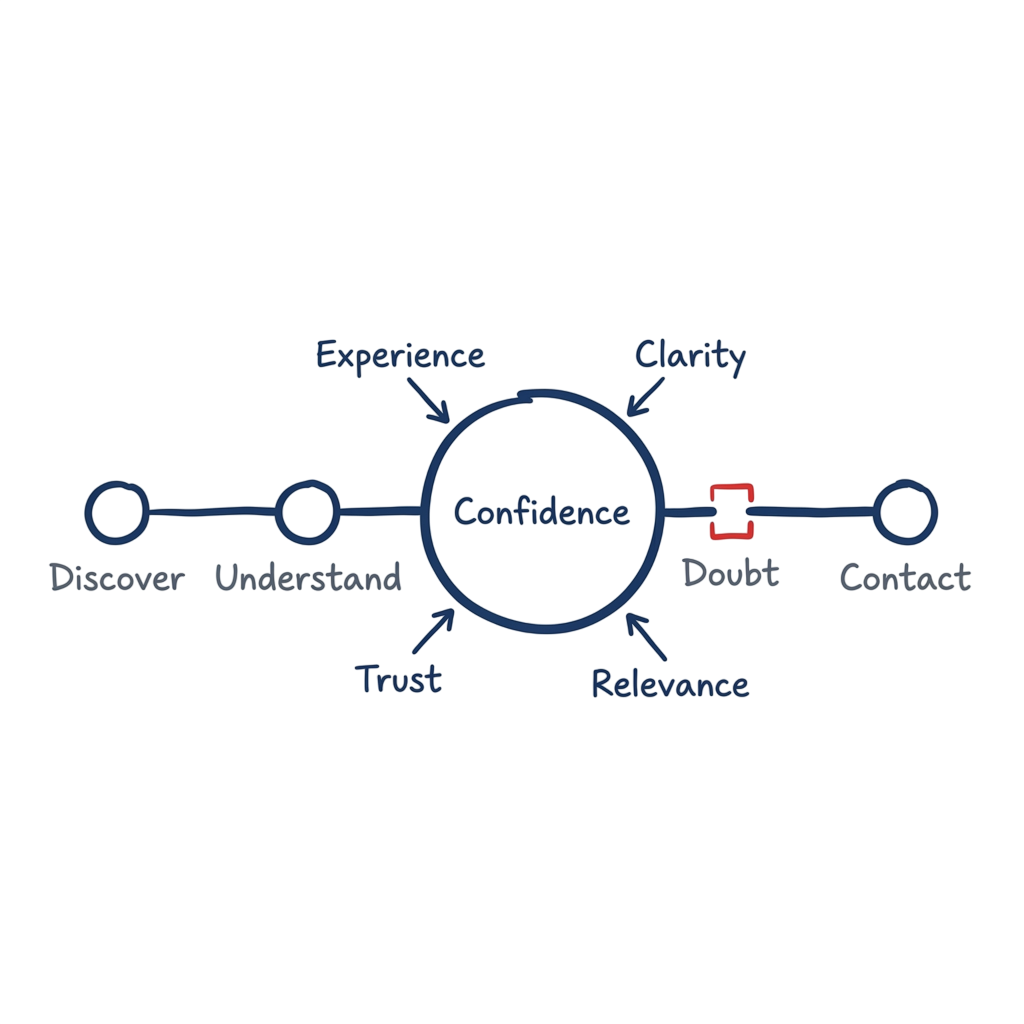
For architects, the buyer journey often looks like this: Discover → Understand → Trust → Choose
A client may discover your firm through Google, a referral, Instagram, LinkedIn or another professional connection.
Then they research → They visit your website → They study your projects → They compare your expertise → They look for evidence →They form an opinion. Only then are they ready to start a conversation.
So effective lead generation for architects is not simply about getting more attention, it is about making your expertise easier to recognise.
The question worth asking
Instead of asking only: “How do we generate more leads?” ask:
“What is preventing the right buyers from recognising our expertise?”
That question changes the strategy, it moves the focus from more marketing activity to stronger digital authority.
And that is the gap many architecture firms need to solve first.
What Lead Generation for Architects Actually Means
Lead generation for architects is the process of attracting potential clients, building their confidence in your expertise, and moving the right prospects towards a project conversation.
It is more than getting website traffic or collecting enquiry forms:
The Digital Authority Gap: Where Architecture Firms Lose Buyers.
1. Discovery
Can the right clients find you?
2. Relevance
Can they quickly understand what you specialise in and whether you’re suitable?
3. Proof
Can they see credible evidence of your capability?
4. Decision
Is it clear what they should do next?
The important point is this: Not every lead-generation problem requires more marketing, some require closing an authority gap.
When buyers can discover your firm, understand its expertise, trust its capability and validate its experience, the path to a meaningful conversation becomes much clearer.
Why Traditional Lead Generation Thinking Breaks Down for Architects
Many lead-generation strategies assume a simple path: more visibility → more enquiries → more projects. For architecture and design, that is incomplete. These are high-consideration services where clients assess judgement, experience, relevance and trust before committing to a significant project.
A prospective client may discover your firm through search, social media or a referral, then visit your website, study your projects and compare your capabilities before making contact. That means an enquiry is often the result of buyer confidence, not the beginning of it.
Your website therefore needs to do more than display completed projects. It should help a serious prospect understand your relevance, assess your capability and know what to do next.
This is why simply increasing traffic, posting more frequently or collecting more contact details may not solve an architecture firm’s acquisition problem.
The strategic point: lead generation becomes stronger when the firm’s digital presence helps the right prospects make a confident decision.
Where Architecture Firms in India Can Find New Project Opportunities
There is no single lead-generation channel that works for every architecture firm.
The right mix depends on project type, location, client profile, ticket size and buying cycle. For most Indian architecture practices, opportunities can come from six broad sources.
1. Search
Google Search and Google Maps can help architecture firms become discoverable when prospective clients are actively searching for relevant services. A complete, accurate Google Business Profile supports local visibility.
- Architect for residential projects in _
- Commercial architect in Bengaluru
- Interior architect in Mumbai
- Sustainable architecture firm in Delhi
Search is particularly valuable because it can connect a firm with existing project intent.
2. Referrals
Referrals remain important in architecture because the service involves considerable trust and investment.
Past clients, contractors, developers, consultants, real-estate professionals and other industry relationships can become sources of new opportunities.
The strategic opportunity is to make referrals repeatable rather than accidental.
3. Professional Networks
Architects operate within interconnected ecosystems.
Developers, builders, real-estate professionals, contractors, consultants and other specialists can introduce projects that may never appear through conventional online search.
4. Social Platforms
Platforms such as Instagram and LinkedIn can help architecture firms build recognition beyond their existing network.
The strongest use is not simply publishing finished projects.
It is consistently demonstrating how the firm thinks about architecture, projects, materials, constraints and the built environment.
5. Industry Platforms
Relevant architecture directories, professional associations, design platforms and local listings can provide additional discovery points.
They should complement, not replace the firm’s own digital presence.
6. Existing Relationships
Previous clients and professional contacts are often an underused source of future opportunities.
A structured approach to staying visible within these relationships can create opportunities without constantly searching for new audiences.
The strategic point
These channels should not be treated as six separate marketing activities, they should work together: Search creates discovery → Content creates understanding → Proof supports evaluation → Relationships create opportunity → A strong digital presence connects them.
For an architecture firm, the objective is therefore not to be everywhere, it is to build the right combination of channels around the kinds of projects and clients the firm actually wants to attract.
Build Authority Assets That Support Lead Generation
Once a prospective client discovers your firm, your digital presence has one important job: Help them evaluate your expertise. For architecture firms and design studios, a small number of well-developed assets can do this better than constant marketing activity.
Project case studies that show how you think
Don’t present a project as a gallery of finished photographs. Explain: Brief → Challenge → Design response → Key decisions → Result
This gives prospective clients insight into how your firm approaches real projects.
Project and service pages
Create focused pages for the work you want to be known for.
A residential architecture firm, for example, may need stronger pages around villas, independent homes or residential developments rather than one generic “Our Services” page.
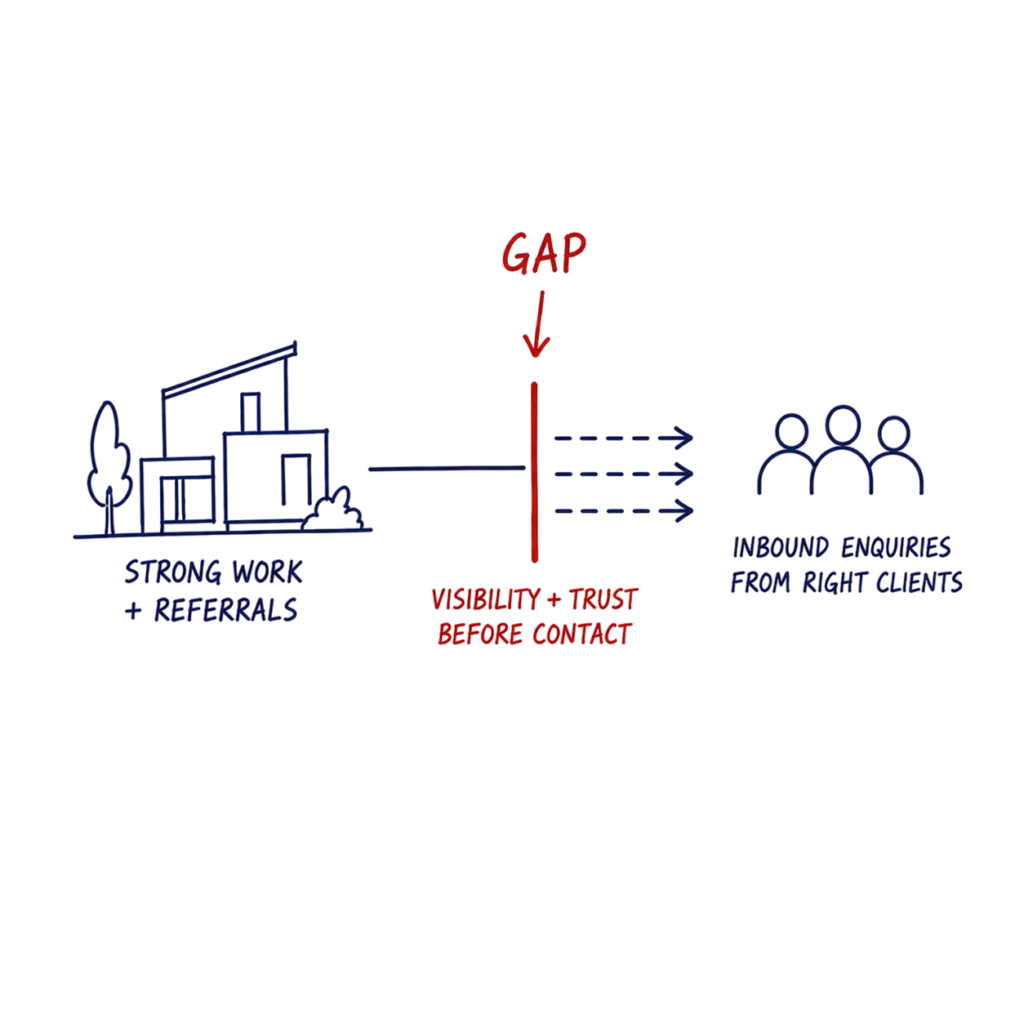
In one architecture and design engagement, the priority was not simply increasing traffic, but helping prospective buyers evaluate the firm’s capability before making contact—contributing to consistent inbound enquiries beyond referrals and stronger project discussions.
“Sameer restructured our digital presence completely. Within six months, we were getting more enquiries—and better ones. Clients were already understanding what we do before contacting us.”— Ar. Ananth, Ashwin Architects
Client proof
Use authentic testimonials and relevant project evidence to reinforce credibility.
Specific experiences are more useful than generic statements such as “Excellent service.”
Expertise-led content
Answer questions your prospective clients genuinely consider before appointing an architect.
This could include project planning, design considerations, architectural processes, common mistakes or insights from completed projects.
The objective is not to publish more, it is to make your firm’s expertise visible in places where prospective clients are evaluating their options.
A clear next step
Finally, make it easy for an interested visitor to understand what happens next — A consultation request, project enquiry or assessment should not feel like a leap into the unknown. Tell them what information to provide and what the initial conversation is intended to establish. Together, these assets create something more valuable than a promotional website:
A digital body of evidence that helps qualified prospects make a better decision.
Build a Lead Generation System You Can Actually Judge
As a founder or principal, you don’t need another list of marketing activities — You need to know whether your firm’s market presence is creating the right opportunities.
Think of lead generation as one connected business system: Right Market → Authority → Enquiry → Opportunity
Start by deciding which projects and clients you actually want more of. Then make sure those prospects can discover your firm, quickly understand its relevance, see credible evidence of your capability, and know how to begin a conversation.
Judge the system by opportunity quality
Don’t make “number of leads” the headline metric, ask:
- Are we attracting the projects we want?
- Are enquiries coming from the markets we serve?
- Which channels create meaningful conversations?
- Are prospects arriving with a clearer understanding of our expertise?
- Are we becoming less dependent on personal referrals?
These questions tell you far more than website traffic, social-media reach or raw enquiry numbers. The real measure is simple:
Is our digital presence making the firm easier for the right clients to discover, understand, trust and choose?
If it is, your lead generation is becoming an authority system rather than a collection of marketing activities.
A Practical 90-Day Direction for an Architecture Firm
Lead generation for architects and design firms does not need to begin with doing everything at once. Start by fixing the areas that most affect how your expertise is discovered and evaluated.
Days 1–30: Diagnose
Identify where recognition and conversion are being lost.
Days 31–60: Build
Strengthen the highest-value authority assets.
Days 61–90: Activate
Connect those assets to search, referrals, professional relationships and relevant platforms.
The objective after 90 days is not simply more marketing activity. It is to answer one strategic question: Is the market beginning to recognize the expertise that already exists inside the firm?
From Expertise to Digital Authority
If your firm already has the expertise, experience and project record, the next question is not necessarily: “What marketing should we do?”
It may be: “What is preventing the market from recognising what we already know and do well?”
That is where Aidasinc approaches lead generation differently: “We help expertise-driven businesses identify the gaps between capability and market perception, then build the digital authority assets needed to close them.”
For an architecture firm, that means turning existing expertise into a stronger market position—one that helps the right prospects recognise the firm’s relevance and capability.
The objective is not to promise a certain number of leads or projects, it is to make your firm easier to discover, easier to trust and easier to choose.
Ready to understand where the gap is? Start with a diagnosis, not a marketing package.
Frequently Asked Questions About Lead Generation for Architects
Lead generation for architects is the process of attracting potential clients and helping the right prospects move from discovering an architecture firm to considering a project conversation. It can involve search, referrals, professional networks, content, digital platforms and other channels.
There is no single best lead-generation channel for every architecture firm. The right mix depends on the firm’s project type, location, ideal client and buying cycle. In many cases, a combination of search visibility, referrals, relevant professional relationships and strong digital authority assets provides a more sustainable foundation than relying on one channel.
Yes, when it connects the firm’s expertise with relevant search intent. For example, an architecture firm may benefit from being discoverable for searches related to its project types, specialisations and locations. But visibility alone is not enough—the website must also help prospective clients evaluate the firm’s relevance and capability.
Start by defining the projects and clients the firm actually wants to attract. Then build visibility and authority around those priorities. Relevant project evidence, focused website content, case studies and a clear enquiry path can help prospective clients determine whether the firm is suitable before making contact.
Referrals can be highly valuable, particularly in a trust-driven profession such as architecture. The risk is becoming entirely dependent on them. A stronger long-term position combines relationship-driven opportunities with a digital presence that allows new prospects to discover and evaluate the firm independently.
There is no universal timeframe. Results depend on factors such as the firm’s existing reputation, competition, location, digital presence, project cycle and chosen channels. Search visibility and authority-building generally require sustained effort rather than a short-term campaign.
Look beyond the number of enquiries. Track whether the firm is attracting the right project types, where qualified opportunities originate, which digital assets prospective clients engage with and whether enquiries progress into meaningful conversations.
The most useful question is: Are the right prospects becoming more confident about choosing the firm?