

Lead Generation for Architects: Build a Website That Buyers Trust
Building a website for architects and design firms that actually generates qualified leads is not simply about getting more people to visit. It is about helping the right buyers understand an architecture firm, trust its expertise, evaluate its work, and feel confident enough to start a conversation.
That distinction matters.
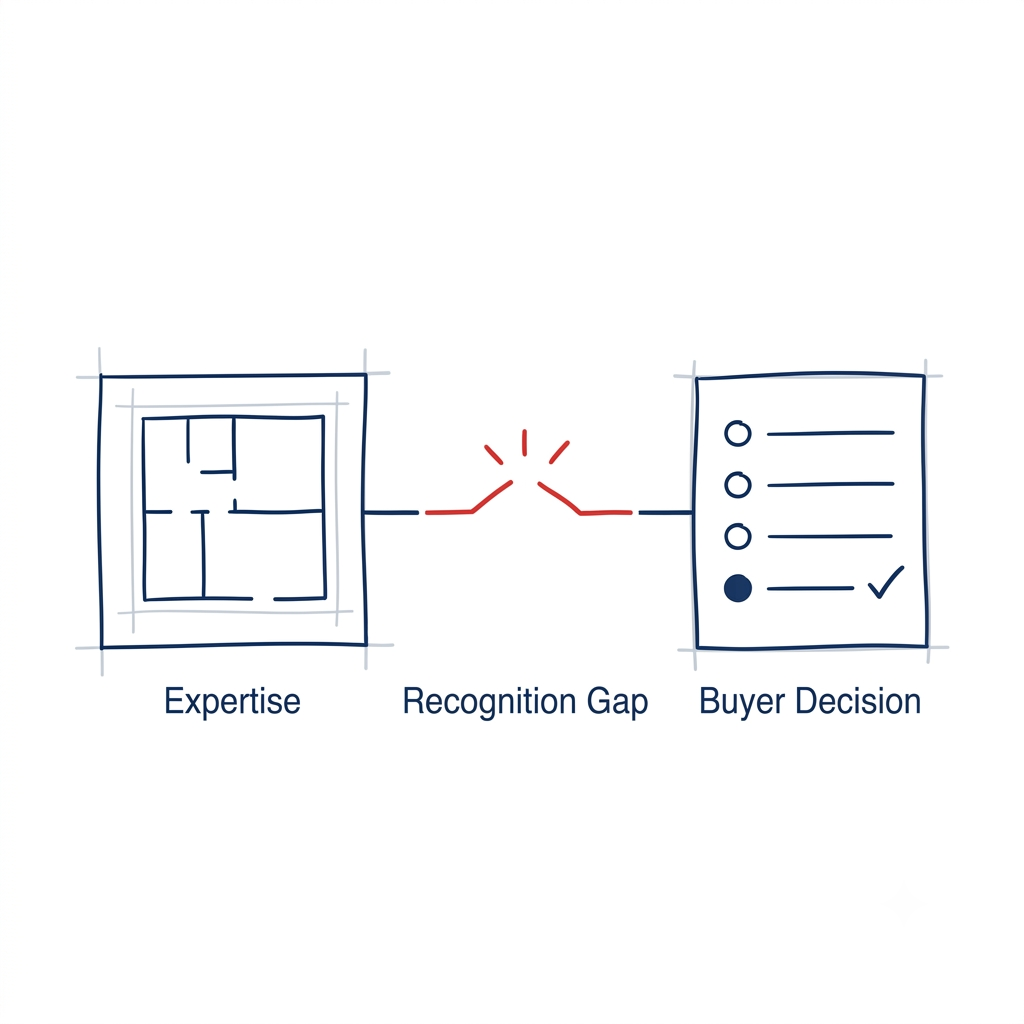
The recognition gap problem.
An architecture firm can have exceptional projects, years of experience, talented designers and a strong referral reputation—and still have a website that produces very little qualified enquiry, stalling your overall architectural design practice marketing efforts.
The problem may not be a lack of expertise. It may be a gap between what the firm can do and what the market can recognize.
A strong lead generation website for architects should close that gap.
Why architecture firms struggle with lead generation
When an architecture firm says, “Our website isn’t generating enough leads,” the immediate response is often to look for more traffic. So, improve SEO / run advertising / post more frequently / how architects can get real leads from websites / add a contact form / offer a downloadable guide, becomes the natural go-to scope. Yes, those activities can have a place, but they don’t solve the underlying problem if a prospective client arrives at the website and still cannot answer basic questions about the firm.
For example:
- Is this firm right for my type of project?
- Have they solved problems similar to mine?
- Do they understand my priorities?
- What makes their approach different?
- Can I trust their judgement?
- Can I see evidence of their capability?
- What should I expect if I contact them?
If the website doesn’t answer those questions, increasing traffic can simply increase the number of people who leave without taking action.
The better model
Instead of thinking about lead generation as: Traffic → Website → Enquiry think about the buyer’s journey as: Discover → Understand → Trust → Validate → Choose. That is the foundation of effective lead generation for architects.
A beautiful architecture website can still fail to generate qualified enquiries
Architecture is highly visual – That naturally makes the portfolio the center of many architecture websites. Large project photographs / Beautiful renderings / Minimal navigation / Awards / Project names / A short description and Repeat have become the norm. But the result can look impressive while leaving a prospective client with surprisingly little information about why the firm should be considered.
A portfolio demonstrates what you have produced, but a high-authority website also needs to demonstrate: how you think, what you understand, what problems you solve, and why your experience matters to this particular buyer. That is a different job.
A buyer isn’t necessarily asking: “Can these architects design something beautiful?” They may actually be asking: “Can I trust these people with a complicated, expensive and important decision?” Your website needs to help them answer that question.
The six authority gaps that affect lead generation for architects
At Aidasinc, we look at the gap between business expertise and market recognition through a series of authority gaps. These gaps are useful because they reveal why a website may underperform rather than simply identifying that it underperforms.
1. Discovery Gap: Can the right prospective clients find the firm?
A website cannot influence buyers who never encounter it. So search visibility, referrals, industry mentions and other discovery channels therefore matter, but discovery is only the beginning.
Getting found does not automatically create preference.
2. Understanding Gap: Can a prospective client quickly understand what the firm is particularly good at?
This is where many architecture websites become too broad. From “We create innovative spaces” and “We design meaningful environments” to “We believe architecture transforms lives” — These statements may sound appropriate, but they do not necessarily help a buyer understand the firm’s practical relevance. A stronger website makes expertise easier to recognize, for example:
- project types
- building types
- sectors
- locations served
- specific capabilities
- recurring project challenges
- design philosophy
- relevant experience
The objective is not to make the firm sound narrower than it is, it is to make its relevance easier to understand.
3. Trust Gap: Does the website give the buyer enough reason to believe the firm can handle the project?
Trust can come from many sources:
- relevant experience
- detailed project evidence
- testimonials
- recognised work
- professional credentials
- founder expertise
- industry participation
- transparent methodology
- useful educational content
The important point is that trust should be demonstrated, not merely announced. Saying “we are experts” is a claim, but showing how the firm approached a difficult project is evidence.

4. Proof Gap: Can buyers validate the firm’s capability before contacting it?
This is where the traditional project gallery often falls short, for example a photograph can show the result, but a case study can explain the thinking behind the result — consider the difference.
Portfolio approach
- Project: Luxury Residence
- Location: Mumbai
- Images: 12 photographs
Authority approach
- Client situation: What was the client trying to achieve?
- Project constraints: What made the project difficult?
- Design challenge: What problem needed to be solved?
- Strategic decisions: What did the architects decide and why?
- Execution: How was the solution developed?
- Outcome: What changed for the client, occupants or project?
The first one is useful, but limited. The second approach, introducing for example a house design firm marketing case study, gives a prospective buyer something much more valuable: a way to evaluate expertise, this aligns with core principles found in B2B web usability and decision-making research.
5. Differentiation Gap: Why should a prospective client choose this firm instead of another capable architecture practice?
“Experienced” / “Creative” / “Client-focused” / “Innovative” / “Passionate”
Most firms can make similar claims, here differentiation becomes stronger when it is connected to a real characteristic of the firm’s expertise. It might be:
- a particular project type
- a distinctive design philosophy
- a specialised technical capability
- a particular client segment
- unusual project experience
- a specific approach to sustainability
- a strong understanding of a particular context
- a distinctive way of managing complex constraints
The website should make that difference understandable and provable.
6. Decision Gap: What is stopping the buyer from taking the next step?
Sometimes the problem is not persuasion, it is uncertainty, the buyer may not know:
- whether their project is suitable
- whether the firm works in their area
- when they should approach an architect
- what information they should prepare
- whether an initial conversation is appropriate
- what happens after submitting an enquiry
A good website reduces unnecessary uncertainty, that is an important part of lead generation for architects.
What a lead generation website for architects should actually do
A website should not behave like a digital brochure, it should function as a pre-conversation authority system. Before the first call, it should help the buyer understand four things:
- What you know: Demonstrate relevant expertise.
- What you have done: Provide credible evidence.
- How you think: Explain methodology, decisions and perspective.
- Why it matters to the buyer: Connect expertise to the problems they actually need to solve.
This changes the role of the website as it is no longer simply: Portfolio + About + Contact and becomes: Expertise + Evidence + Understanding + Confidence + Decision

Six Questions Your Project Pages Should Answer
For many architecture firms, the portfolio is the strongest authority asset they already possess. Here the opportunity is to make it work harder, so instead of presenting every project in the same format, identify the information that helps a prospective buyer evaluate capability. A strong project page can answer:
- What was the project? Give the basic context.
- What was difficult about it? Explain the meaningful constraint or challenge.
- What did the firm need to solve? Move beyond aesthetics.
- What decisions were made? Show the thinking.
- Why were those decisions important? Explain the reasoning.
- What was achieved? Describe the outcome using evidence that can genuinely be supported.
This turns project experience into a reusable authority asset.
Five questions your website should answer before a buyer contacts you
A prospective client should not have to investigate your entire website to understand your relevance. The important answers should be easy to find.
- Are you experienced in projects like mine? Show relevant work rather than simply claiming broad experience.
- Do you understand the problem I am facing? Use industry insights, project examples and educational content to demonstrate understanding.
- What makes your approach different? Explain the actual difference rather than relying on generic positioning language.
- Can I trust the quality of your work? Provide evidence: projects, case studies, credentials, recognition, testimonials or other legitimate proof.
- What happens if I contact you? Remove unnecessary uncertainty from the first step.
A clear next step can be simple: Discuss your project, rather than an aggressive: GET A FREE CONSULTATION NOW!
The objective is confidence, not pressure.
What to remove from an architecture website
Improving lead generation does not always mean adding more, sometimes authority improves when unnecessary material is removed.
- Don’t add another project gallery if your existing projects lack context. More images do not necessarily create more confidence, better evidence often beats more evidence.
- Don’t describe every project with the same generic language. If every project says “innovative,” “sustainable,” “timeless” and “functional,” the words stop differentiating the firm.
- Don’t make the homepage carry every message. A homepage should establish the firm’s relevance and authority. Detailed expertise can then be demonstrated through dedicated pages, projects, insights and case studies.
- Don’t use a lead magnet simply because someone says every website needs one. A useful resource can help a buyer, an unnecessary form can simply create friction. The asset should solve a genuine problem.
- Don’t hide expertise behind architectural jargon. Technical knowledge is valuable, but the website should translate that knowledge into language the intended buyer can understand.
The smarter way to approach lead generation for architects
Before investing more in traffic, advertising or content production, examine the website itself. Ask:
- Discovery — Can the right buyers find us?
- Understanding — Can they quickly understand our expertise?
- Trust — Do they have enough reason to believe us?
- Proof — Can they validate our capability?
- Differentiation — Can they see why we are worth considering?
- Decision — Do they know what to do next?
If several answers are “no,” the problem may not primarily be lead generation, it may be an authority gap.
A practical authority checklist for architecture firms
Use this as a quick diagnostic.
| Diagnostic Question | Yes / No | Authority Impact & Fix Action |
| Can a visitor understand what we specialise in quickly? | [ ] | Fix: Narrow down generic positioning statements into specific building types and capabilities. |
| Is our most relevant project experience easy to find? | [ ] | Fix: Feature targeted case studies right on primary landing pages instead of burying them. |
| Do our project pages explain the thinking behind the work? | [ ] | Fix: Transition from simple photo galleries to challenge-decision-outcome case study frameworks. |
| Can prospective clients understand how we approach complex projects? | [ ] | Fix: Document methodology steps clearly to lower buyer risk perceptions. |
| Is our differentiation specific rather than generic? | [ ] | Fix: Remove words like “innovative/timeless” unless tied to explicit technical proof. |
| Do we provide credible evidence of our expertise? | [ ] | Fix: Embed testimonials, credentials, and real-world project constraints. |
| Can buyers find answers to important questions before contacting us? | [ ] | Fix: Build an upfront FAQ and clear expectations section for first-time callers. |
| Does our website address common concerns and objections? | [ ] | Fix: Explicitly define project scales, geographic boundaries, and engagement models. |
| Is the next step clear without being aggressive? | [ ] | Fix: Swap high-pressure CTAs (“GET A FREE CONSULTATION NOW!”) with consultative alternatives. |
| Does the website reflect the level of expertise we actually possess? | [ ] | Fix: Audit structural authority gaps to bridge the offline-to-online reputation divide. |
The last question may be the most important, because there is a difference between having expertise and making that expertise visible to the market.
Lead generation starts before the lead
A qualified enquiry rarely begins with the contact form. The buyer may have spent days—or much longer—forming an opinion about the firm. They may have:
- searched for relevant expertise
- reviewed project work
- compared firms
- read an article
- looked at the founder’s background
- examined case studies
- checked reviews or recognition
- discussed the firm with someone else
- returned to the website more than once
The enquiry is simply the visible moment when that accumulated confidence becomes action, and that is why a website should not be judged only by whether it contains a prominent contact button. Its deeper job is to increase buyer certainty.
The Aidasinc model: from expertise to recognition
Aidasinc approaches this problem through Digital Authority Architecture. The model is simple: Expertise ➔ Authority Assets ➔ Buyer Confidence ➔ Market Recognition
Authority assets can include:
- strategic websites
- case studies
- frameworks
- industry insights
- knowledge resources
- buyer education
- project evidence
- point-of-view content
- proof systems
The purpose is not to create more marketing activity for its own sake, it is to make genuine expertise easier for the market to recognize.
Before spending more on lead generation, ask these six questions
- Can the right buyers discover us?
- Can they understand our expertise?
- Do they trust what they see?
- Can they validate our capability?
- Can they understand why we are different?
- Can they confidently decide what to do next?
If the answer to all six is yes, your website has a stronger foundation for generating qualified demand. If several are no, more traffic may not be the first problem to solve. The better starting point may be diagnosing the authority gaps between your expertise and the way the market currently perceives it.
Assess your digital authority
Aidasinc helps expertise-driven businesses identify the gaps between what they are genuinely capable of and what prospective buyers can recognize online.
The starting point is not another marketing campaign, it is understanding where buyer confidence is being lost.
Frequently Asked Questions
Lead generation for architects is the process of attracting and converting prospective clients who may require architectural services. Effective lead generation goes beyond attracting traffic: the firm’s digital presence should help relevant buyers understand its expertise, trust its capability, evaluate its work and take an appropriate next step.
Start by identifying the type of client and project the firm wants to attract. Then make the firm’s relevant expertise, project experience, differentiation and proof easy to understand. A website should answer important buyer questions before asking visitors to enquire.
A strong architecture website combines relevant project evidence, clear positioning, useful information, credible proof, understandable messaging and a clear next step. It should help prospective clients evaluate the firm’s expertise rather than simply display a portfolio.
SEO can help the right buyers discover an architecture firm, but visibility alone does not create buyer confidence. SEO works more effectively when the destination page clearly demonstrates relevant expertise and gives visitors enough information to evaluate the firm.
Not necessarily. A lead magnet can be useful when it solves a genuine problem for the intended buyer. It should not be added simply to collect contact details. For many architecture firms, strong project evidence, decision guides and useful educational content may be more relevant authority assets.
A useful case study should explain the business or project context, the challenge, the firm’s diagnosis or design thinking, important decisions, the solution and the supported outcome. This allows prospective clients to evaluate how the firm thinks, not just what the finished project looks like.
Look at whether prospective buyers can discover your expertise, understand your relevance, trust your claims, validate your capability, see your differentiation and confidently identify the next step. Gaps in any of these areas can reduce the website’s ability to turn expertise into buyer confidence.


Lead Generation for Architects & Interior Designers: Build Digital Authority

Sophia – Tailored Social Media Content for Interior Designer of Luxury Residences

Top 5 Lead Generation Challenges For Interior Designers – Solved

Top Architects In Pune – What Does Ranking On Top Mean [Updated]

Video Marketing Plan for Interior Design Firms – The Real Secrets

Top Architects In Mumbai – A Constructive Online Presence Analysis
Tailored Social Media Content for Residential Architects and Designers

Social Media Marketing for Architects: The Key to Boosting Your Firm’s Success