

What Happens When Every Industrial Valve Supplier Looks Qualified?
During a recent Growth Gap Analysis on Industrial Valve Supplier Differentiation, for manufacturers and suppliers serving specialty chemical plants and petrochemical facilities across the Dahej–Ankleshwar–Bharuch industrial corridor, one commercial pattern appeared repeatedly.
Technically qualified suppliers were still struggling to become the preferred choice. The reason was not immediately obvious.
Most Industrial Valve Manufacturers Think They Need More RFQs.
The Market Evidence Suggests They Have A Preference Problem.
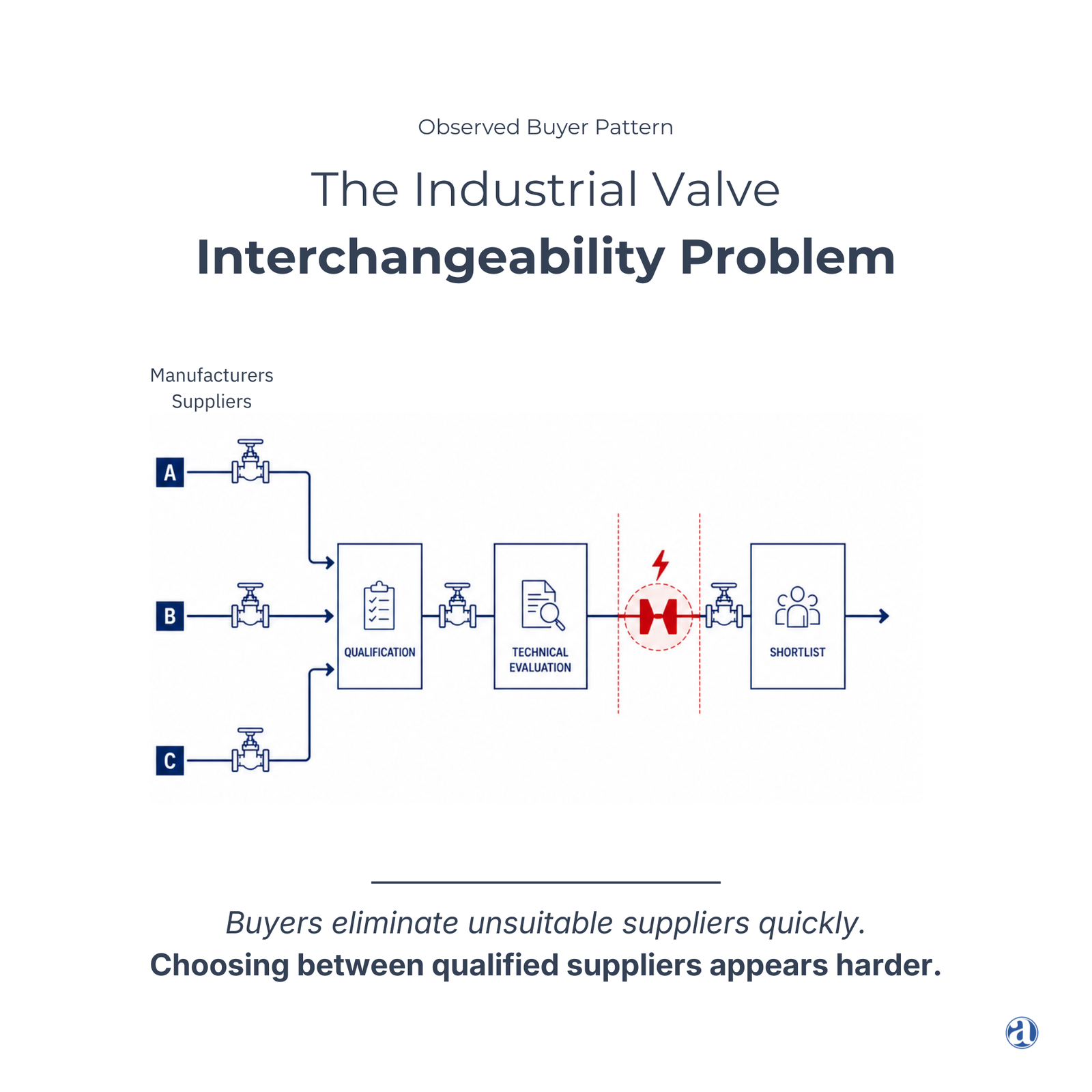
A specialty chemical plant needs severe-service control valves for a critical process application. The industrial buying process begins long before an RFQ is issued. They see five suppliers that appear technically qualified.
All have certifications, all have engineering capability, and all have relevant references. The technical evaluation process has already eliminated suppliers that fail basic engineering, quality, and compliance requirements.
The buyer’s problem is no longer finding suppliers. The buyer’s problem is deciding which supplier deserves preference.
That distinction appears to be far more commercially significant than most manufacturers realise.
That is where many industrial valve manufacturers begin losing commercial advantage.
Most manufacturers assume inconsistent growth comes from:
- Not enough visibility
- Not enough enquiries
- Not enough leads
- Not enough RFQs
After studying severe-service control valve suppliers serving specialty chemical and petrochemical facilities in the Dahej–Ankleshwar–Bharuch industrial corridor, a different pattern emerged.
The Growth Constraint May Not Be What Most Manufacturers Assume.
The evidence pointed repeatedly toward a commercial pattern that most manufacturers do not actively measure, yet its effects appeared across supplier evaluations, procurement discussions, and buying decisions. The pattern appeared often enough that it became one of the primary areas investigated in the Growth Gap Analysis.
What made the finding particularly interesting was not its visibility.
It was the size of its apparent commercial impact.
Twenty years ago, technical qualification often created differentiation. Today, it is increasingly the minimum requirement for consideration as most established suppliers already possess:
- Engineering expertise
- Manufacturing capability
- Industry certifications
- Application experience
- Relevant references
As qualification standards converge, buyers naturally begin asking a different question:
Not:
Can this supplier manufacture the valve?
But:
Why is this supplier the most relevant choice for our situation?
One finding surprised us — The companies generating the most RFQs were not always the companies creating the strongest commercial preference. Why? The answer became one of the central themes of the analysis.
Another unexpected observation emerged. Several suppliers appeared highly qualified on paper, yet buyers consistently struggled to explain why one should be preferred over another. The implications of that finding were larger than expected.
The analysis suggested a gap between how suppliers communicate and how buyers make decisions. Understanding the exact nature of that gap became one of the primary objectives of the analysis.
The Question Most Valve Manufacturers Are Asking:
How do we generate more RFQs?
The Question That Appears To Unlock Growth:
How do we help buyers prefer us before industrial procurement begins comparing suppliers?
To investigate this issue, we completed a market analysis focused on severe-service control valve manufacturers serving specialty chemical and petrochemical buyers in the Dahej–Ankleshwar–Bharuch industrial corridor.
The analysis uncovered several recurring commercial patterns affecting growth predictability. Some were expected, others challenged widely held assumptions about how industrial buyers evaluate suppliers.
Most growth constraints do not appear as a single lost order, they appear as:
- Longer sales cycles
- More RFQs required to win the same revenue
- Greater pricing pressure
- Lower conversion efficiency
- Less predictable growth
The Growth Gap Analysis investigates whether these outcomes may share a common underlying cause.
Why Do Technically Qualified Suppliers Still Struggle To Become The Preferred Choice?
The answer appears to have less to do with technical capability than many manufacturers assume. Most suppliers will never identify this constraint because they are measuring RFQs, not preference formation.
Request The Full Growth Gap Analysis
The complete report investigates a question few valve manufacturers are asking: Why do technically qualified suppliers still struggle to become the preferred choice?
Inside the Analysis:
• How buyers in specialty chemical plants and petrochemical facilities actually evaluate industrial valve suppliers
• The hidden stage of the industrial buying process where commercial momentum appears to slow
• Why some technically qualified suppliers are shortlisted more consistently than others
• The commercial patterns influencing industrial supplier selection before procurement comparison begins
• The most likely structural constraint affecting growth predictability
• The observable evidence supporting that conclusion
• A diagnostic framework for determining whether the same pattern may exist inside your business
This analysis was developed using the Aidasinc Growth Gap Analysis methodology. The objective was not to identify marketing tactics, but to identify the most likely structural constraint limiting predictable growth.
The complete analysis was developed for decision-makers operating in technical industrial markets where supplier selection involves engineering, reliability, maintenance, procurement, EPC, and project stakeholders.